
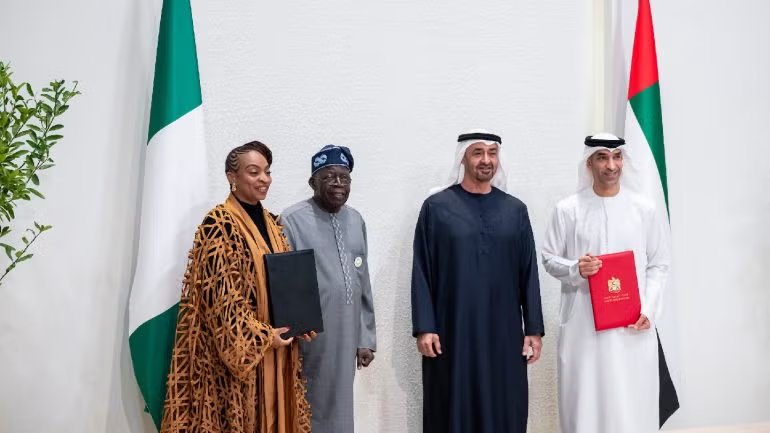
ABU DHABI – Nigeria has cemented a Comprehensive Economic Partnership Agreement (CEPA) with the United Arab Emirates, a deal President Bola Tinubu describes as a “historic and strategic milestone” designed to catalyze capital inflows and modernize Africa’s fourth-largest economy. Announced during the 2026 Abu Dhabi Sustainability Week, the pact eliminates tariffs on over 7,000 Nigerian products and outlines deep cooperation in renewable energy, aviation, and digital trade. For a Nigerian administration that has spent the last three years aggressivey courting foreign direct investment, the agreement serves as a vital gateway to Middle Eastern markets and a critical endorsement of its ongoing fiscal reforms.
The partnership arrives as Nigeria pivots toward a “Climate and Green Industrialization” strategy, aiming to mobilize between $25 billion and $30 billion in annual climate finance. Central to this ambition is the newly unveiled $2 billion National Climate Change Fund and a $500 million Distributed Renewable Energy Fund, both of which seek to bridge the country’s chronic energy gap through decentralized, sustainable power. The President highlighted that these efforts are already resonating with the markets; a 50 billion-naira sovereign green bond issued in 2025 was nearly 100% oversubscribed, signaling robust investor appetite for Nigerian green assets despite broader macroeconomic headwinds.
“The deal marks a ‘historic and strategic milestone’ between one of Africa’s biggest economies and the Gulf state,” President Tinubu told delegates, emphasizing that climate action is now being positioned as a primary driver of job creation rather than a regulatory burden. This sentiment was echoed by Trade Minister Jumoke Oduwole, who noted that the CEPA provides Nigerian businesses with a “gateway to the rest of the world.” Beyond trade in goods, the agreement is expected to facilitate a critical aviation breakthrough, with Emirates Airline slated to resume flights to Abuja in the first quarter of 2026, a move seen as essential for restoring seamless business travel and logistics between the two nations.
The collaboration also extends into the high-tech frontier, with Nigeria seeking Emirati expertise in artificial intelligence to optimize its aging national grid and accelerate the rollout of sustainable power to underserved rural areas. This technological leap is supported by the Electricity Act of 2023, which has already begun to decentralize the power sector. To further convert this diplomatic momentum into tangible commitments, Nigeria is set to co-host the Investopia global investment platform in Lagos this February, bringing together a consortium of global policymakers and institutional investors to vet the country’s $25 billion green project pipeline.
As the Tinubu administration reports a 21% surge in non-oil exports and over $50 billion in total investment commitments, the UAE partnership is being viewed as the linchpin for the next phase of Nigeria’s economic diversification. By securing duty-free access for agricultural and industrial goods—ranging from oil seeds to pharmaceuticals—the deal aims to scale local manufacturing for export while shielding the economy from the volatility of global crude prices. The success of this pact will likely be measured by the speed at which these “historic” signatures translate into operational factories and stabilized power for Nigeria’s 200 million citizens.
